White Ware
 Decoration
As peak season approaches, hotels, restaurants and catering businesses naturally focus on menus, staffing and guest capacity. Yet another operational detail can have an equally important effect on service: having the right number of plates, bowls and cups in circulation.
Too little tableware can leave service teams waiting for the next wash cycle, slow down plating and create inconsistencies during the busiest periods. Buying too much, however, increases costs and consumes valuable storage space.
So, how much tableware does a restaurant really need?
The answer depends on more than the number of seats. Service format, menu structure, table turnover, washing capacity and reserve stock must all be considered when establishing an effective tableware par level.
What Is a Tableware Par Level?
A tableware par level is the minimum quantity of each item required to maintain smooth service during normal and peak operations.
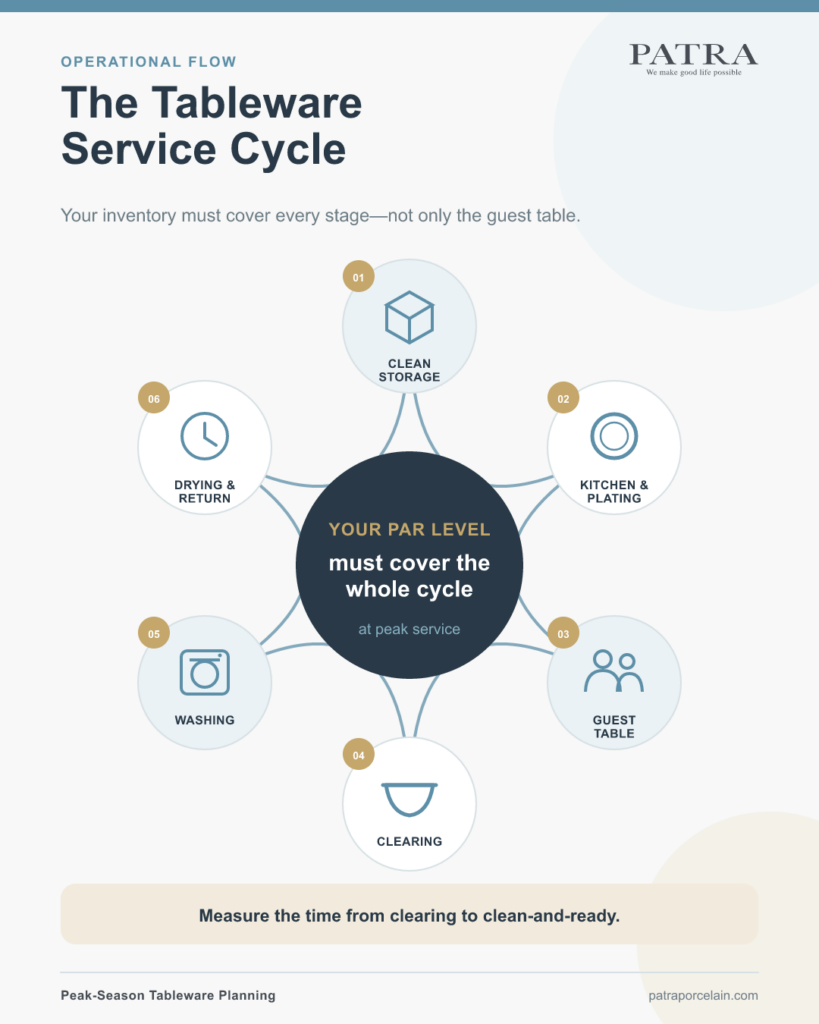
This quantity must cover tableware in several parts of the service cycle:
- Pieces currently being used by guests
- Pieces being prepared or plated in the kitchen
- Used pieces waiting to be collected
- Pieces moving through the washing process
- Clean pieces ready for the next order
- Reserve stock for breakage, loss and unexpected demand
Two restaurants with the same number of seats may therefore require very different quantities. A multi-course fine-dining restaurant will not use tableware in the same way as a café, while a banquet operation may need hundreds of identical plates ready at the same time.
A Practical Tableware Planning Formula
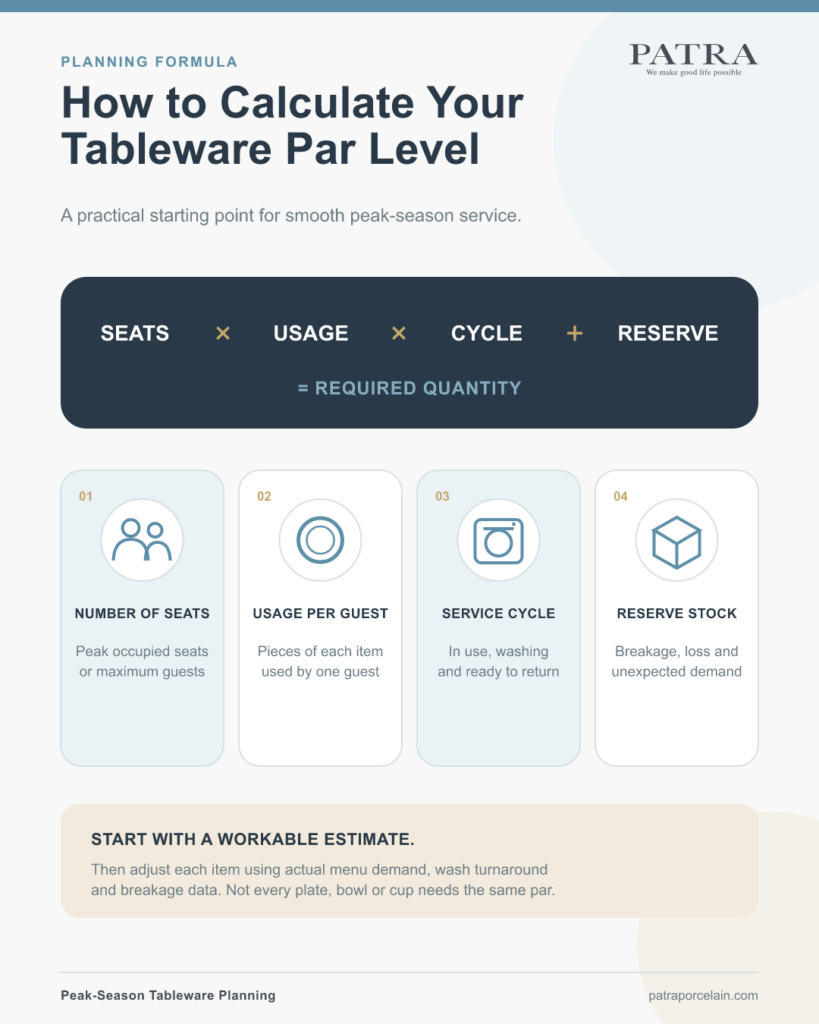
An initial quantity can be estimated with the following formula:
Number of seats × usage per guest × service-cycle factor + reserve stock
Each part of the formula should be assessed separately.
1. Number of Seats or Maximum Guest Capacity
For a restaurant, begin with the maximum number of occupied seats expected during peak service.
For a banquet or event venue, use the maximum number of guests that may need to be served simultaneously. Unlike an à la carte restaurant, a banquet operation may need to stage or plate an entire course before service begins.
2. Usage per Guest
Not every piece of tableware is used at the same rate.
A main plate may be required for every guest, while only a percentage of guests will order coffee. A tasting menu may use several plate shapes during one meal, whereas a casual restaurant may use one versatile plate for multiple dishes.
Quantities should therefore be calculated by item. Applying the same par level to every plate, bowl, cup and serving piece can result in unnecessary stock in some categories and shortages in others.
3. Service-Cycle Factor
The service-cycle factor represents the number of pieces circulating through the operation before an item becomes available for reuse.
The cycle begins when a clean piece leaves storage and includes plating, service, clearing, washing, drying and returning the item to the service area.
A restaurant with a fast and efficient washing system may require fewer pieces in circulation. A property with distant service areas, limited washing capacity or several functions operating at the same time may need a higher par level.
For frequently used items, many operators may begin their assessment at approximately two to three pieces per seat and then adjust the figure to match actual service conditions. This is a planning reference rather than a universal rule.
4. Reserve Stock
Reserve stock covers pieces that are chipped, broken, lost or temporarily removed from service. It also provides flexibility when guest numbers are higher than expected.
The appropriate reserve should reflect the operation’s breakage history, replenishment lead time, product availability and the importance of each item to the menu.
Example: Calculating Tableware for a 100-Seat Restaurant
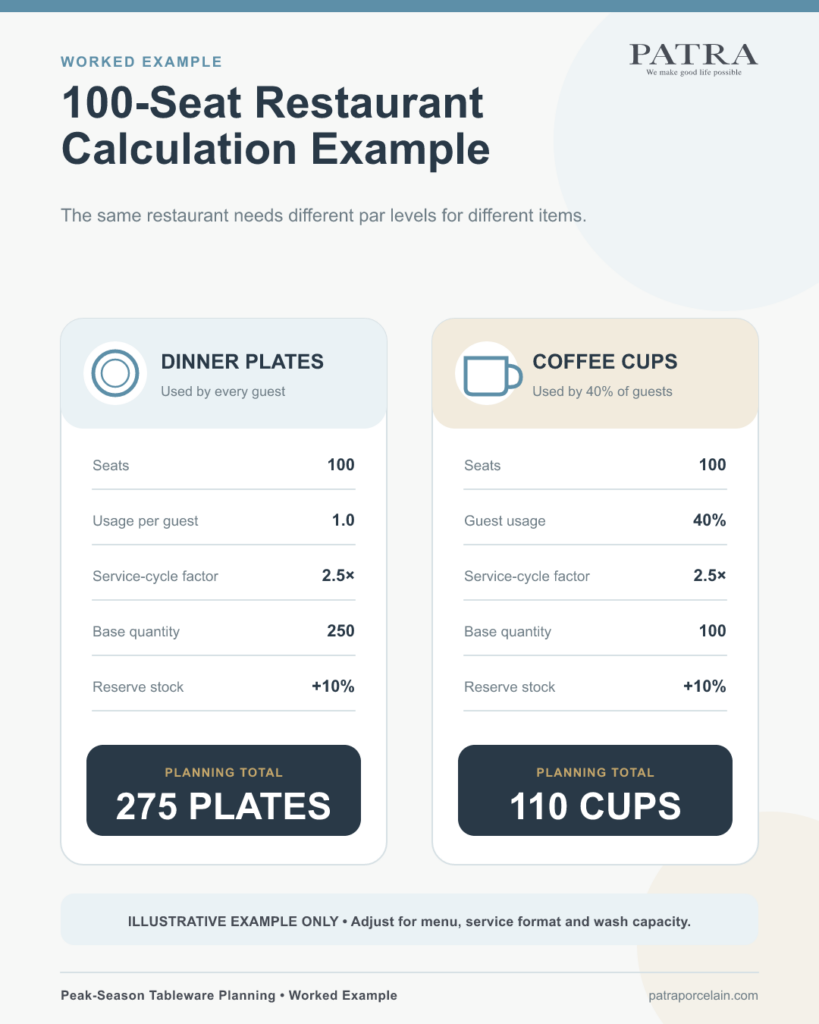
Consider a 100-seat restaurant calculating its requirement for main dinner plates.
If every guest uses one dinner plate and the operation requires approximately 2.5 sets in circulation, the initial calculation would be:
100 seats × 1 plate per guest × 2.5 = 250 plates
Adding a 10% reserve gives:
250 + 25 = 275 plates
The restaurant could therefore begin planning around 275 dinner plates and refine the number using actual operating data.
Coffee cups should be calculated differently. If approximately 40% of guests order hot beverages:
100 seats × 40% × 2.5 = 100 cups
After adding a 10% reserve, the initial requirement would be approximately 110 cups.
This example demonstrates why every tableware category should not be assigned the same par level.
What Affects the Amount of Tableware Required?
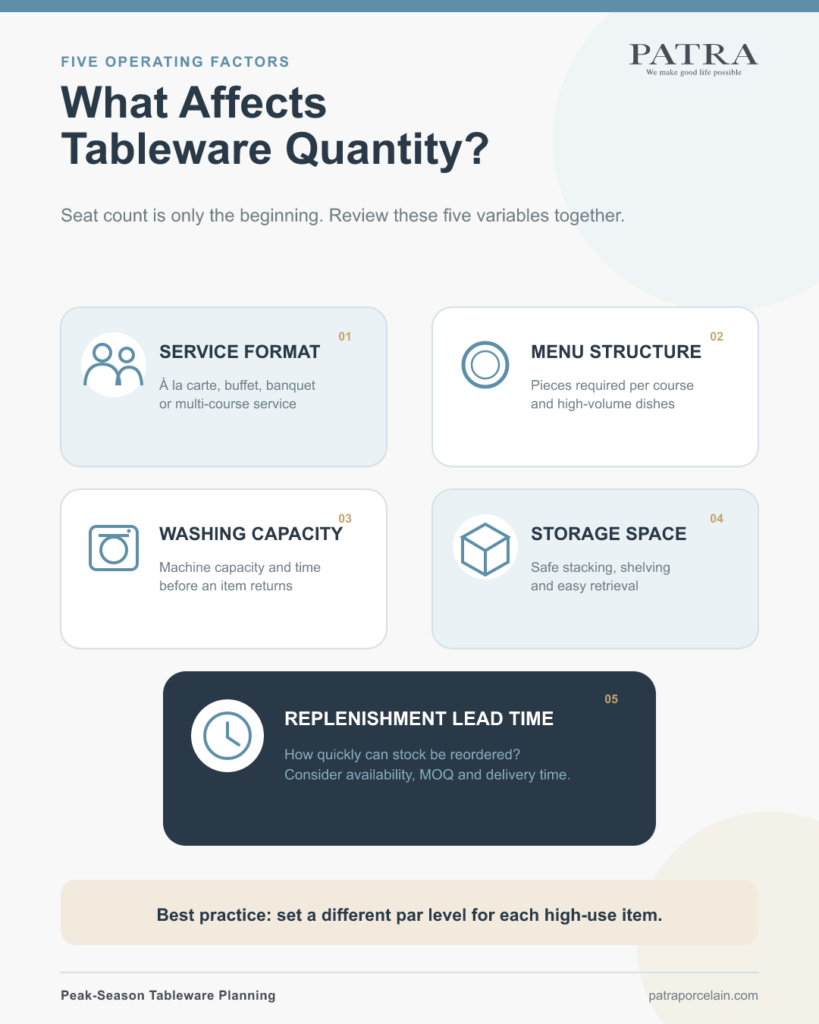
1. Service Format
À la carte restaurants may be able to wash and reuse some pieces between table turns. Buffets and banquets often require a larger quantity to be prepared before service begins.
Fine-dining restaurants may also use more pieces per guest because each course is presented on a different plate or bowl.
2. Menu Structure
Review which dishes are ordered most often and which tableware pieces are shared across several menu items.
Pieces used for signature dishes and high-volume menu items should normally have a higher par level than specialised pieces used only occasionally. Selecting versatile shapes can also reduce the number of different items that must be purchased and stored.
3. Washing Capacity
Machine capacity, wash-cycle duration, kitchen layout and staffing all affect tableware requirements.
One useful exercise is to measure the time between a plate being cleared from the table and becoming clean, dry and available again. If this process takes longer than the restaurant’s table-turn cycle, additional stock may be needed to prevent shortages.
4. Storage Space
A high quantity does not improve operations if tableware cannot be stored safely and accessed efficiently.
Professional tableware should stack securely, fit the available shelving and allow service teams to retrieve the required pieces without unnecessary handling.
5. Replenishment Lead Time
Tableware that can be reordered consistently reduces the risk of mismatched service pieces. Before setting a reserve level, operators should review product availability, order quantities and expected production or delivery time.
Pre–Peak Season Tableware Checklist
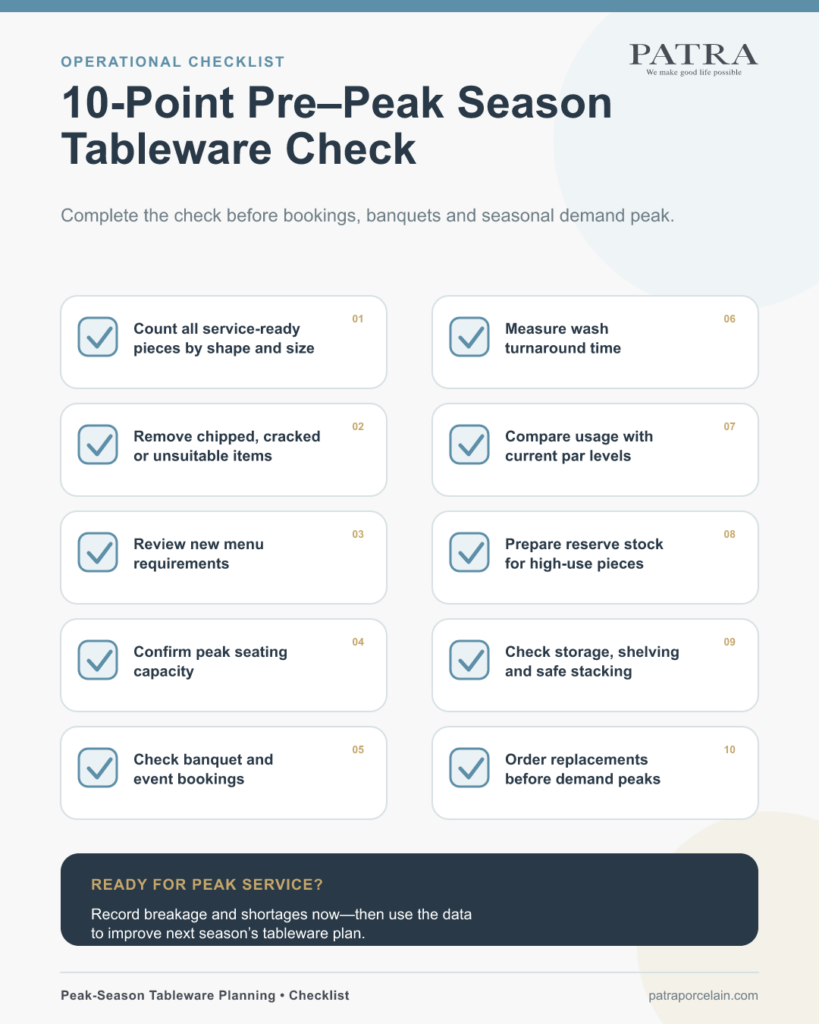
Before entering the busiest part of the year, hospitality teams should:
- Count all service-ready tableware by shape and size
- Remove chipped, cracked or unsuitable pieces
- Review new menu items and their tableware requirements
- Confirm seat capacity, reservations and banquet bookings
- Check washing capacity and turnaround time
- Compare actual usage with existing par levels
- Build reserve stock for high-use pieces
- Review shelving, stacking and storage safety
- Place replenishment orders before demand peaks
- Record breakage and loss for future planning
Better Tableware Planning Supports Better Service
Effective restaurant tableware planning is not simply about purchasing more plates, bowls and cups. It is about balancing service efficiency, cost, storage capacity and presentation standards.
Tableware designed for hospitality should perform reliably through repeated service and washing cycles, stack securely and support the menu’s presentation requirements. When the right products are combined with realistic par levels, restaurants can reduce service delays, control inventory more effectively and deliver a consistent guest experience—even during the busiest periods.
PATRA Porcelain offers professional tableware for hotels, restaurants, cafés and banquet operations, with a wide range of shapes and sizes designed to support different menus and service formats.
Frequently Asked Questions
How many plates does a 100-seat restaurant need?
There is no single number that suits every restaurant. For high-use dinner plates, an initial estimate may be two to three plates per seat, or approximately 200–300 plates for a 100-seat restaurant. The final quantity should reflect the service format, wash cycle and reserve requirements.
What does a three-par tableware level mean?
A three-par level generally means keeping three pieces per seat—for example, one in use, one in the washing process and one clean or ready for circulation. However, not every tableware category needs the same three-par quantity.
How much reserve tableware should a restaurant keep?
Reserve stock should be based on breakage history, replenishment time and the importance of the item to service. An operation may begin with a reserve of approximately 10–20% and adjust it using actual inventory data.
Which tableware items need the highest par level?
Items used by most guests or across several popular dishes usually require the highest par levels. These may include main plates, bread plates, versatile bowls and coffee cups in beverage-led operations.
How often should restaurant tableware be counted?
Tableware should be counted regularly according to the volume and complexity of the operation. Additional inventory checks should be completed before peak season, major banquets, menu launches and periods with unusually high reservations.